Success criteria
How to know
How to know
if it worked.
S-01
A date-first user can discover options on a specific date within 3 taps from the home screen, without using search.
Behavioral
S-02
A title-first user completes their existing flow with zero additional friction introduced by the new entry point.
Non-regression
S-03
Date selected in discovery carries through to booking, the user never re-enters their date constraint.
Consistency
S-04
The presence of two entry modes is understandable on first use, without tooltips, onboarding, or explanation copy.
Clarity
S-05
Sessions starting with date-first discovery achieve equivalent booking completion rates to title-first sessions.
Outcome
Design explorations
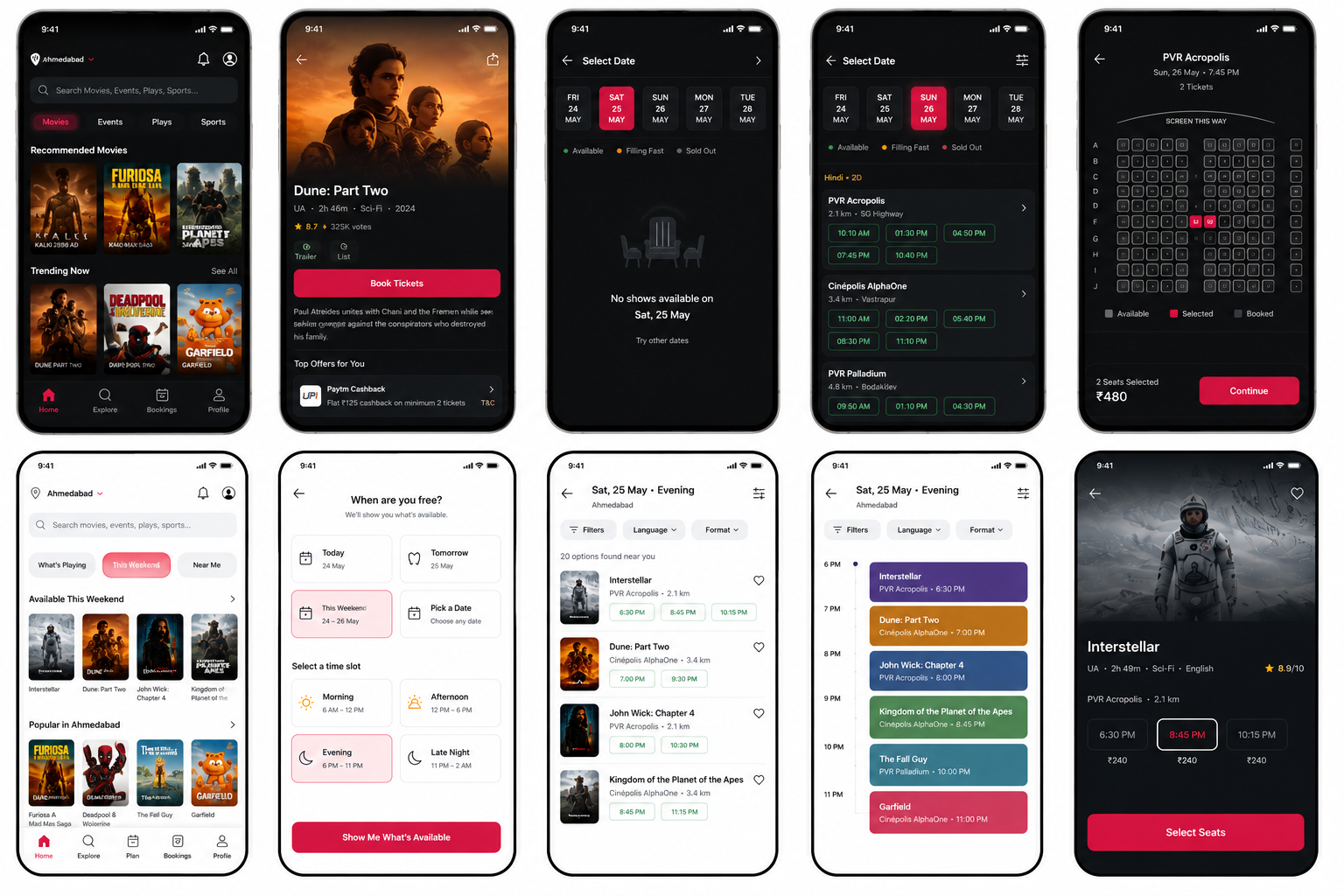
Designing a date-first discovery experience.
Instead of forcing every user into a movie-first flow, the redesign introduces a parallel discovery path for people who begin with a free evening and want to explore available options.
Concept prototype exploring a date-first discovery model for users who begin with a free day rather than a specific movie title.
A new entry point for discovery.
The proposed experience allows users to start with a date, discover available options, and then narrow choices based on preferences, reducing unnecessary navigation and repeated filtering.
Reflections
Designing for different mental models.
- 01Mental model mismatches don't always create error states. Users adapt, work around, and tolerate. The friction is real, but silent. That's the most dangerous kind.
- 02Calling a problem a "UI problem" or an "IA problem" changes the solution entirely. Diagnosis accuracy matters as much as solution quality.
- 03Success criteria written before wireframes change the quality of the wireframes. When you know specifically what "working" looks like, you design toward it instead of hoping.
- 04Adding a new flow to an existing product is a different skill than designing from scratch. Non-regression, ensuring existing users aren't disrupted, is a first-class design constraint.