AI-Powered Mobile Inspection App

Anzenn

Transforming safety inspections from documentation-heavy workflows into AI-assisted field experiences.

RoleUX Designer
Product TypeAI-Powered Mobile Inspection App
PlatformMobile, Field Use
Structure7 Findings → 7 Decisions · 3 Principles

The goal wasn't to build
a better camera app.

Safety inspectors in construction work under real pressure. They're on site with equipment and hazards around them, documentation requirements following them everywhere. The expectation is that they capture, annotate, and report accurately, without losing the pace of the inspection itself.

Anzenn needed to fit into that reality. Not sit on top of it.

This project was driven independently. There was no Business Analyst involved in discovery or requirements gathering. I conducted the research, synthesized findings, identified workflow patterns, defined the problem space, and translated those insights into product decisions and interface concepts.

Inspectors don't need another camera app.
They need less documentation work.

Seven findings from
watching inspectors work.

Evidence board, root cause trace
Observation
Inspectors take photos during rounds but write notes separately, hours later
Evidence
Documentation deferred = memory-dependent reporting = errors and omissions in final reports
Insight
The gap between capture and context is where accuracy dies, annotation must happen at the moment of capture
Decision
Inline annotation, tag, voice note, severity, must complete before returning to the checklist
F-01
Inspectors context-switch constantly. Physical observation, device interaction, verbal communication, sometimes within seconds. Tools that demand sustained attention fail in the field.
F-02
Documentation is deferred. Most inspectors capture photos in the moment and document later, creating a memory load that directly increases errors and omissions in reports.
F-03
The checklist mental model is deeply entrenched. Inspectors think in items to complete, not forms to fill. Navigation that fights this creates friction at exactly the wrong moment.
F-04
Photo annotation is a significant pain point. Adding context to photos after the fact requires navigating away from the inspection flow, losing momentum on the round.
F-05
Report generation is treated as a separate task. The gap between "inspection complete" and "report submitted" introduces compliance risk. Inspectors deprioritize it under time pressure.
F-06
Status visibility matters at a glance. Inspectors need to know what's done, what's pending, what's flagged, without expanding any item or digging into sub-menus.
F-07
Connectivity is unreliable on site. Any feature requiring a live connection to function creates a single point of failure in a workflow where failure has real consequences.
Anzenn Workflow Research
Principle 01
Capture now,
structure later.
Minimize the work at the moment of capture. Log fast and raw. Structure happens in the background, after the pressure is off.
Principle 02
The checklist
is the interface.
Don't fight the mental model. Build navigation around the inspector's existing cognitive framework, not over it.
Principle 03
Offline-first
by default.
Every critical action must work without a connection. Sync when available. Never block the workflow on connectivity.

Each finding.
One decision.

D-01
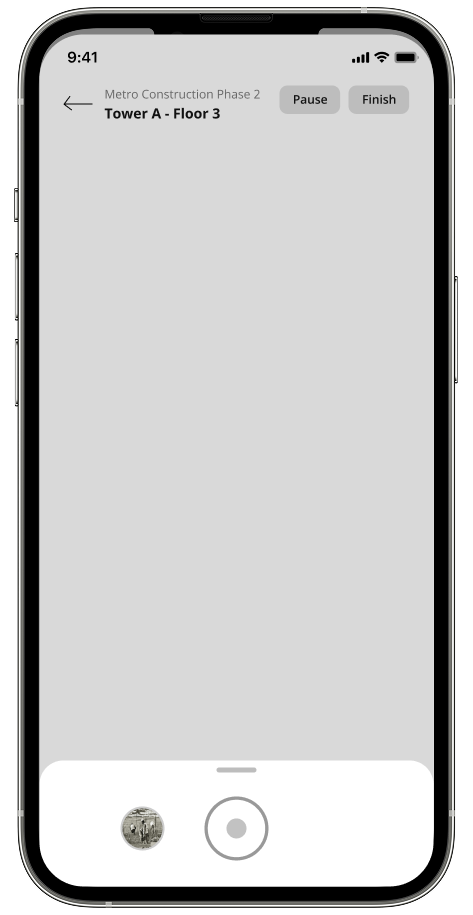
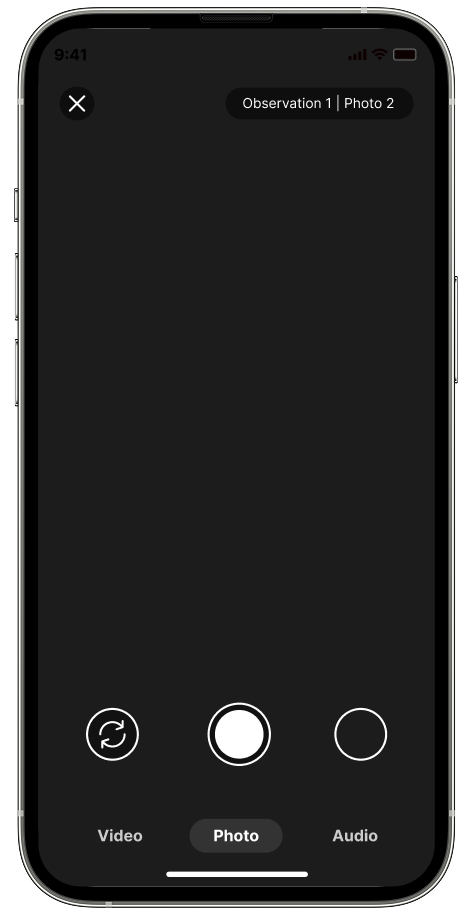
One-tap capture mode. A persistent camera button accessible from anywhere in the app without navigating away from context.
D-02
Inline annotation within capture. Voice note, text tag, severity flag, all before returning to checklist. Annotation and capture happen in one unbroken moment.
D-03
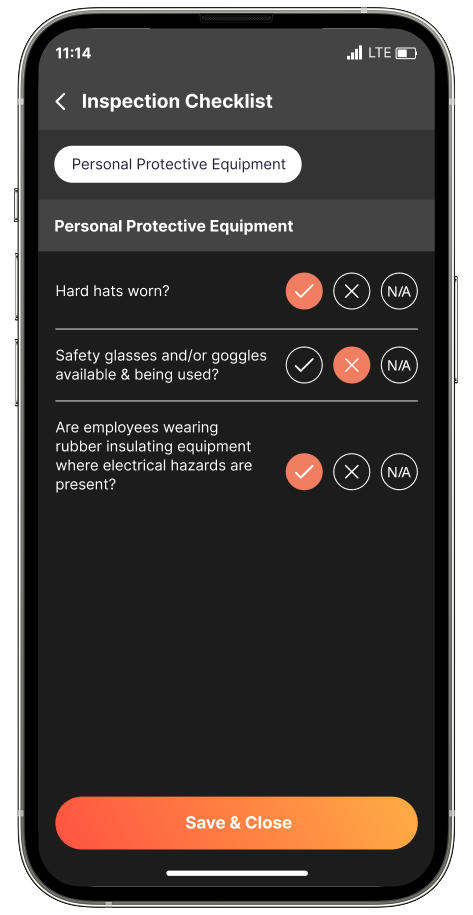
Checklist-first navigation. The home screen is the checklist. Not a dashboard, not a summary. The inspector's first view is their first action.
D-04
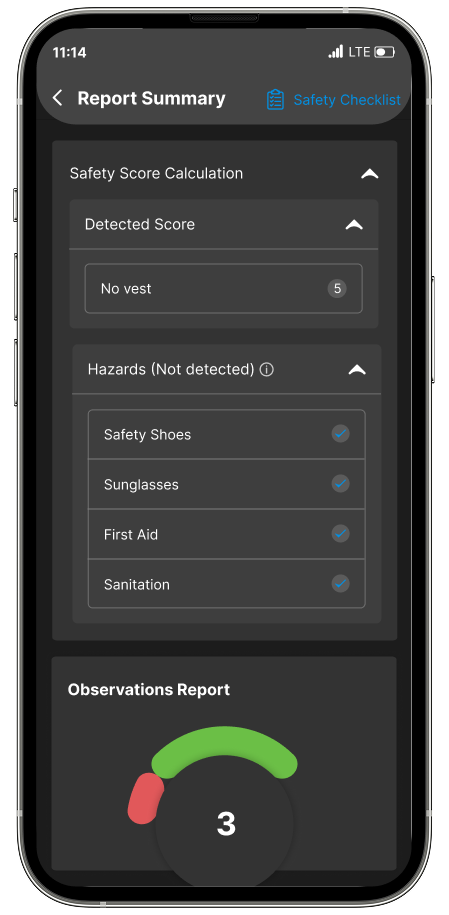
Report auto-drafts in background. As items complete and media is captured, the report compiles automatically. Submission becomes one action at the end, not a separate task.
D-05
Status ring on each item. Untouched, in progress, flagged, complete, visible without expanding any item.
D-06
Full offline capability. Local storage for all captured media and checklist state. Sync indicator, not sync gate.
D-07
Severity triage at the point of discovery. When flagging an item, severity is chosen immediately, not during report review. Triage happens when the context is freshest.

Where principles
become interface.

Wireframe Evolution

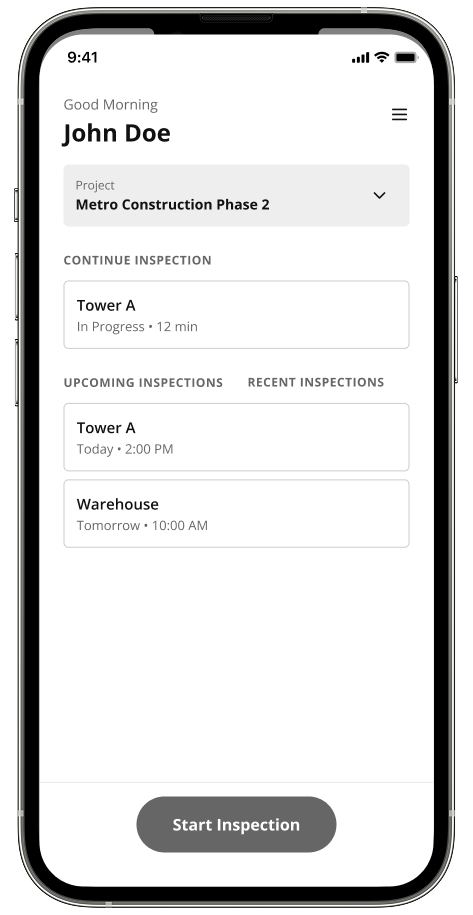
Early exploration focused on reducing documentation overhead and keeping inspectors inside the inspection flow.

Dashboard Wireframe
Camera Flow Wireframe

Final Product Experience

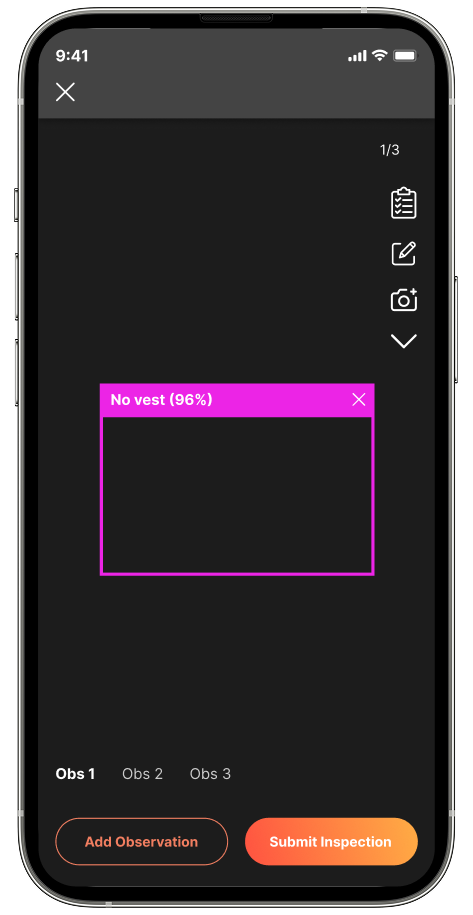
The final experience transformed research findings into a streamlined inspection workflow powered by AI-assisted documentation.

Inspection Checklist
Camera Experience
AI Detection
Report Generation

Designing for field conditions.

Next investigation
Prequaligy →